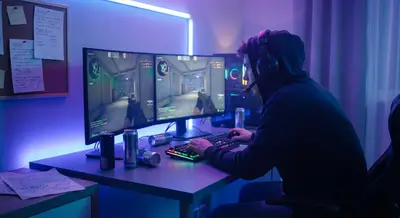
Mindset Over Mechanics: Playing Smarter (Not Sweaty) in Every Game
You’ve tweaked your settings, cranked your FPS, watched a dozen YouTube guides—and you’re still stuck in “pretty good” rank hell. The missing upgrade usually isn’t your mouse or your monitor. It’s your mindset, your habits, and how you actually think while you play. This guide is all about that: not one specific game, but the way elite players approach any title. If you want to climb faster, tilt less, and actually enjoy the grind again, this is your meta-guide to playing smarter, not just harder.
The Hidden Skill Gap: Decision-Making vs. Raw Aim
Most players overrate mechanics and underrate decisions. Your crosshair might be cracked, but if you’re taking dumb fights, rotating at the wrong time, or overcommitting abilities, you’re effectively speedrunning your own loss screen.
Start by thinking in “risk vs. reward” every time you act. Before you ego-chow that corner or solo-push that tower, ask: What do I gain if this works, and what do I lose if it fails? High-risk, low-reward plays are what separate “frag movie” brains from consistent winners. Strong players don’t avoid risk—they choose calculated ones, like taking a 2v1 with superior position or trading cooldowns they know will matter in 10 seconds, not 2.
Replay your own games and track your biggest turning points: deaths, failed pushes, lost objectives. Don’t just label them “unlucky.” Ask: What did I know at that moment? What did I ignore? Was there safer info I could’ve gotten first? This habit silently rewires your decision-making. Over time, you’ll start seeing patterns: maybe you always overextend after winning a fight, or chase kills instead of securing objectives. That’s the real “hidden MMR” gap—your choices, not your flicks.
Building a Personal Game Plan (So You Don’t Just Vibe Every Match)
Most people queue up and free-fall into chaos. No plan, no focus, just vibes and reaction. Strong players enter every match with a personal game plan based on their role, character, and win conditions.
Start simple: define your “job” each game. Are you entry fragging, peeling for your backline, shot-calling rotations, or anchoring a site/point/position? Your job isn’t “top frag,” it’s “do the thing that makes my comp win more games.” If you’re a support or utility-heavy character, your scoreboard won’t always tell the story—your impact often hides in timing, positioning, and enabling others.
Before the match starts, set one clear focus: maybe it’s “play closer to team,” “communicate rotations earlier,” or “only take fights with cover.” You’re not trying to fix your entire game in one night; you’re stacking micro-upgrades. Mid-match, if things go south, reset by returning to that focus. Lost three rounds in a row? Cool—go back to basics: play safe, trade for teammates, and stop hero-playing alone.
At the end of a session, review: Did I actually follow my plan? If not, why? Tilt, distraction, bad habits? That honesty is more valuable than blindly blaming teammates or “bad RNG.” Your plan should evolve as you improve—once basics are autopilot, upgrade your goals to deeper stuff like reading enemy patterns, managing cooldowns more efficiently, or controlling key map areas.
Tilt Control: Turning Bad Games into Free Lessons
Tilt isn’t just “getting mad”; it’s any emotional state that hijacks your decision-making. You know you’re tilted when you start queuing “one more” with dead eyes, chasing dumb fights, or arguing more than you’re actually playing. That’s when your MMR quietly bleeds out.
Step one: learn your personal tilt flags. Do you start hard-peeking angles you’d normally clear? Stop talking in voice? Spam surrender votes? Those are early warnings. When you catch these, don’t power through like a hero—reset. Stand up. Change your physical state: stretch, drink water, walk around. It sounds basic, but your brain reacts heavily to small physical resets.
Mentally, reframe bad games as “expensive coaching sessions you’ve already paid for.” You suffered; now at least learn from it. Instead of obsessing over the final scoreboard, pick one key mistake or pattern to fix next time. Maybe you notice you always die first when you push past chokepoints alone, or you panic your ultimate whenever an enemy appears. That awareness is value extracted from pain.
Also, protect your mental stack. Not every session has to be a ranked sweat-fest. Mix in casual modes, single-player games, or totally different genres when you feel burnout creeping in. Competitive focus is a resource—you can’t run it at 100% forever without crashing, just like real athletes burn out if they never rotate training intensity or take breaks.
Communications That Actually Win Games (Not Start Arguments)
Comms are a weapon—most lobbies just use them like a blunt object. You don’t need to be a full-on shot-caller to boost your win rate with smarter communication; you just need to be clear, short, and calm.
Drop the useless noise: flaming, sarcasm, or vague calls like “he’s over there” do nothing but clutter the channel. Instead, use concrete info: positions, numbers, resources. For example: “Two pushing left, no ult on tank, I have mine in 10” is infinitely more useful than “stop feeding left” or “team?” Keep your voice neutral even when things go wrong—everyone plays better when they’re not feeling attacked.
If your team is silent, you can still lead by making low-pressure suggestions: “We can group and hit A together,” “Let’s play for picks, not full push,” or “Play slow, they used big cooldowns last fight.” Think “suggest” not “command.” You’ll be surprised how often randoms will follow someone who sounds calm and slightly confident.
When someone is tilting or flaming, you’ve got three tools: ignore, defuse, or mute. Trying to win a logic battle mid-match is usually a waste. Sometimes a simple, “All good, new round, reset,” actually cools people off. If they’re unfixable, mute and move on. Protect your focus first—your individual impact will still matter more than arguing.
Adapting to the Meta Without Becoming Its Prisoner
Every game has a “meta”—the most effective strategies, characters, builds, or tactics at a given time. Ignoring the meta completely usually holds you back, but blindly copying it without understanding why it works traps you at mid-skill.
Think of the meta as “default strong options,” not “mandatory character locks.” Start by understanding what the current meta is trying to abuse: is it burst damage, sustain, speed, poke, crowd control, or something else? Once you see the pattern, you can either join it or find ways to counter it.
Let’s say everyone runs fast, aggressive comps. Cool—maybe your edge is playing slower, more controlled styles that punish their over-aggression. Or if everyone’s abusing one OP weapon or hero, you should at least know how it works—its strengths, weaknesses, and cooldown patterns—so you can anticipate what those players want and deny it.
Don’t feel forced into playing stuff you genuinely hate just because it’s “meta.” If you despise a top-tier hero, you’ll never master them anyway. Instead, pick something slightly off-meta that still fits the current environment and your personal strengths. Strong players don’t chase every balance patch; they build a flexible toolkit and adjust around it.
Practice Like an Athlete, Not Like a Slot Machine
Most gamers “practice” by spamming queues and hoping muscle memory magically appears. That’s like a basketball player only playing full matches and never doing drills. You don’t need a pro facility to train smarter—you just need intentional reps.
Break your playtime into modes: warm-up, focused practice, and free play. Warm-up is for your hands and eyes: aim trainers, practice ranges, or slow games against bots to get your mechanics firing. Focused practice means targeting a single weakness: maybe only working on crosshair placement, or playing one character/role for a full session to really deepen your comfort.
During focused sessions, set specific mini-challenges: “No dry peeks this game,” “Always trade with a teammate,” “Place vision/utility before every fight,” etc. Track whether you actually did them. Over time, these targeted habits become automatic and free up mental bandwidth for bigger decisions mid-match.
Finally, accept that rest days count as practice. Your brain consolidates skills when you’re away from the game—especially sleep. If your aim suddenly feels worse, or you’re misreading everything, that might not be a “skill issue”; it might be a fatigue issue. Pro scenes talk about sleep, nutrition, and exercise for a reason—they directly impact reaction time, focus, and consistency. You don’t need a full gym routine, but staying even slightly active and hydrated is a real in-game buff.
Conclusion
If your rank feels stuck or your matches feel like pure chaos, it’s probably not just your aim or your gear—it’s how you think, reset, communicate, and practice. Mechanics are the entry ticket; mindset is how you actually win long-term. Start treating every match as a mental game: make plans, spot patterns, protect your focus, and train with intent instead of autopilot grinding. You don’t need pro reflexes or a $3k setup to play on a smarter difficulty level—you just need to bring a different brain to the same lobby.
Upgrade that, and everything else—from your K/D to your sanity—levels up with it.
Sources
- American Psychological Association – The Road to Resilience – Covers mental resilience and coping strategies that translate directly to handling tilt, loss streaks, and pressure in competitive gaming.
- Cleveland Clinic – Effects of Stress on the Body – Explains how stress impacts performance, focus, and decision-making, relevant for high-pressure ranked environments.
- Harvard Medical School – Sleep, Learning, and Memory – Details how sleep supports skill consolidation and reaction time, essential for improving gameplay consistency.
- U.S. Department of Health & Human Services – Physical Activity Guidelines – Outlines exercise recommendations that can improve energy, focus, and overall cognitive performance for gamers.
- Valve – Dota 2 Gameplay Update 7.36 – An example of how meta-shifting patches work in modern games, illustrating why adaptation and understanding patch changes matters for competitive play.