No-Filler Game Reviews: How to Tell a Banger from a Bust in Minutes
Game trailers lie. Store pages overpromise. Hype cycles spin out of control. But your time (and wallet) are limited, and nobody wants to grind through 20 hours just to realize, “Oh… this ain’t it.”
Let’s break down how to actually read game reviews like a pro, spot red flags early, and figure out if a game is worth your download, your grind, and your rage-quits.
What Game Reviews Really Tell You (When You Read Between the Lines)
Most reviews are more than just “good game” or “bad game.” They’re a mix of facts, vibes, and expectations—yours and the reviewer’s.
When you look at a review, focus on:
- Genre expectations: A 7/10 roguelike might be a 10/10 for you if you love punishment and permadeath. Check what type of player the reviewer is talking to.
- Core loop description: Any good review should explain what you’re actually doing most of the time. Shooting? Grinding? Farming? Dialogue? If they can’t summarize it clearly, the gameplay might be mid.
- Context vs. criticism: “The story is short” means something different in a $15 indie versus a $70 AAA release. Price and scope matter.
- Platform differences: Performance on PC vs PS5 vs Switch can be night and day. A game that’s “fine” on console might be a jittery mess on low-end PCs.
- Reviewer bias: Do they love Soulslikes but hate handholding? Do they rave about “cinematic experiences” while barely talking about controls? That tells you how to filter their take.
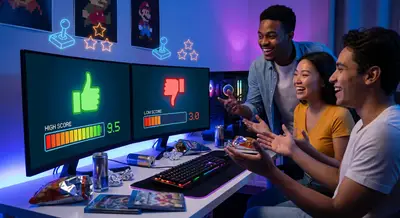
Instead of locking onto the final score, treat the review like you’re asking a teammate, “Is this my kind of game or not?” and reading their ping, not just their kill count.
Gameplay First: Why “Feels” Matter More Than Graphics
The fastest way to know if a game is for you: ignore the graphics for a second and focus on how it plays.
Look for reviews that talk about:
- Movement and control: Is movement snappy or floaty? Is aiming tight or sluggish? For action-heavy games, this is everything.
- Moment-to-moment choices: Are you reacting on instinct or stuck in menus? Constantly pausing to manage gear might be cozy for some players and unbearable for others.
- Difficulty curve: Is it fair-but-tough or cheap-and-frustrating? Reviewers should describe where the game gets hard, not just say “it’s difficult.”
- Repetition vs. variety: Are side quests actually different, or just “kill 10 more things, again”? The best reviews will call out padding.
- Systems depth: If reviewers mention “build variety,” “playstyle options,” or “synergy between abilities,” that’s a good sign for long-term replay value.
Insider tip: If a review spends more time on graphics than on controls and mechanics, you’re not getting the full picture. Pretty doesn’t mean fun.
Story, Worldbuilding, and Vibes: Not Just for “Story Gamers”
Even if you usually skip cutscenes, it’s worth checking how reviewers talk about a game’s world and tone.
Pay attention to:
- Narrative structure: Is it linear, branching, or more environmental (Souls-style lore, logs, item descriptions)? Different structures hit different players.
- Writing style: Quippy Marvel-style banter? Dead-serious drama? Quiet and introspective? Reviews often quote lines or describe the overall tone—this is a big hint.
- Pacing: Do players mention that the story drags in the middle, or that the game takes “10 hours to get good”? That’s huge for time-strapped gamers.
- World density: Is the open world packed with meaningful stuff or just “content”? Reviewers should say whether exploration feels rewarded or like busywork.
- Emotional payoff: Did the ending land? Did the characters grow? Or did it feel rushed and abrupt?
If you see phrases like “I couldn’t put it down,” “I kept thinking about it after I finished,” or “the world feels alive,” those are green flags—especially if multiple reviewers say the same thing.
Multiplayer & Live Service: Reading the Fine Print Before You Commit
Online-focused and live-service games live or die by things a launch-day review can easily miss.
Here’s what to watch for:
- Server stability & netcode: Early reviews and player posts will mention disconnects, lag, rubber-banding, or desync. Don’t ignore these.
- Matchmaking & queue times: A fun game with dead queues might as well be uninstalled. Look for mentions of wait times by mode and region.
- Progression systems: Is the grind satisfying or soul-crushing? Reviewers should talk about how long it takes to unlock key abilities, weapons, or characters.
- Monetization: Battle passes, cosmetics, XP boosts, pay-to-skip, loot boxes—check how aggressive it is, not just whether it exists.
- Post-launch plans vs. track record: What the devs say they’ll do is less important than what they’ve done before. Reviews that reference past support on previous titles are gold.
Insider tip: If a review says “This could be great if the devs fix X, Y, and Z,” don’t buy the potential. Buy what’s actually in the game right now.
How to Use User Reviews Without Getting Baited by Rage
User reviews can be incredibly useful—but also incredibly chaotic.
To use them wisely:
- Sort by “most helpful,” not most recent: You’ll usually see the most thoughtful breakdowns at the top.
- Read a few positives and a few negatives: You’re looking for patterns, not hot takes. If both sides mention the same flaw or strength, believe that.
- Watch for “played X hours”: A 1-hour review and a 100-hour review are very different beasts. Early impressions vs. long-tail issues.
- Filter out review bombs: Sudden waves of negative reviews around controversies (pricing, politics, bugs after a patch) don’t always reflect the actual core game for new players.
- Look for specifics, not vibes: “This game sucks” = useless. “Enemy AI never flanks, and side quests all reuse the same two layouts” = highly useful.
User reviews shine when you’re checking performance on specific setups (e.g., Steam players on mid-range GPUs) or long-term balance issues for multiplayer titles.
Demo, Trial, and Refund: Your Secret Weapons Against Buyer’s Remorse
You don’t have to rely solely on reviews; you can turn your own first impressions into the final verdict.
Smart ways to test a game:
- Free demos and betas: Great for testing feel—movement, combat, performance. Just remember: some betas are older builds.
- Game Pass/PS Plus/other subscriptions: Treat these like “long demos” for big titles. Play 2–3 hours and bail guilt-free if it’s not clicking.
- Refund policies: Steam, for example, allows refunds under specific conditions (currently under 2 hours played and within 14 days of purchase). That’s enough to see if the game completely misses the mark for you.
- Cloud versions/streams: On some services, you can stream before you download to see how it looks and runs.
Insider tip: In your first 1–2 hours, ask yourself:
- Do I like how it feels to move and fight?
- Do I care even a little about what happens next?
- Am I already annoyed by UI, menus, or clunky systems?
If the answer to all three is “not really,” reviews were probably right to be cautious—and you should be, too.
When to Trust the Hype… and When to Wait for Patches
Some games truly are launch-day gems. Others feel like paid early access for the first few months.
Use this quick mental checklist:
Worth grabbing early if:
- Multiple reviewers praise stability and performance on your platform.
- Bugs are mentioned as “minor” or “rare,” not “constant” or “game-breaking.”
- Content feels “complete,” not “we’ll fix it later.”
- The dev team has a strong track record of shipping polished games.
Better to wait if:
- Day-one patches are huge and still don’t fix core problems.
- Performance issues (stuttering, crashes, console frame drops) are everywhere in reviews and social media.
- The endgame is described as “thin” or “repetitive.”
- The dev’s previous titles launched rough and took months to fix.
Waiting 1–3 months can often mean:
- Better performance
- Discounted price
- More content and QoL updates
- Reviews reflecting the current state, not the broken launch version
Conclusion
You don’t need to read every review, watch every streamer, or memorize every patch note to dodge bad buys—you just need to know what to look for.
Treat reviews like squad comms:
- Is this game fun minute-to-minute?
- Does it respect your time?
- Is it stable on your platform?
- Does the monetization feel fair?
- Do people who like the same genres as you actually enjoy it long-term?
Answer those questions—using critic reviews, user impressions, and your own hands-on time—and you’ll spend way less time regretting purchases and way more time saying, “Yeah, this one’s a keeper.”
Sources
- Metacritic – How Metascores Work – Explains how aggregated critic and user scores are calculated and what they represent
- Steam Refund Policy (store.steampowered.com) – Official breakdown of how game refunds work on Steam, including time and usage limits
- BBC – Why Video Games Launch Broken (and Why Players Still Buy Them) – Context on buggy launches, patches, and player expectations around modern releases
- GDC (Game Developers Conference) – Postmortems & Case Studies – Developer talks on game launches, design decisions, and post-launch support that influence how review scores evolve over time
- Sony PlayStation – Game Trials and PlayStation Plus Info – Details on trials, subscription access, and how players can test games before committing fully